


Compensation policy challenges in Tunisia
- 20 February 2026
- Posted by: admin
- Category: Non classé
Introduction – A More Complex Question Than It Appears
Why do companies—particularly those with foreign capital—express a growing need for salary benchmarking in Tunisia, even though the legal framework and sectoral collective agreements define salary grids with precision by role, category, and seniority?
This seemingly paradoxical question actually reveals a deeper structural tension. The real issue is not so much how much to pay, but how to think about compensation in a labor market that has become heterogeneous, fragmented, and subject to multiple economic logics.
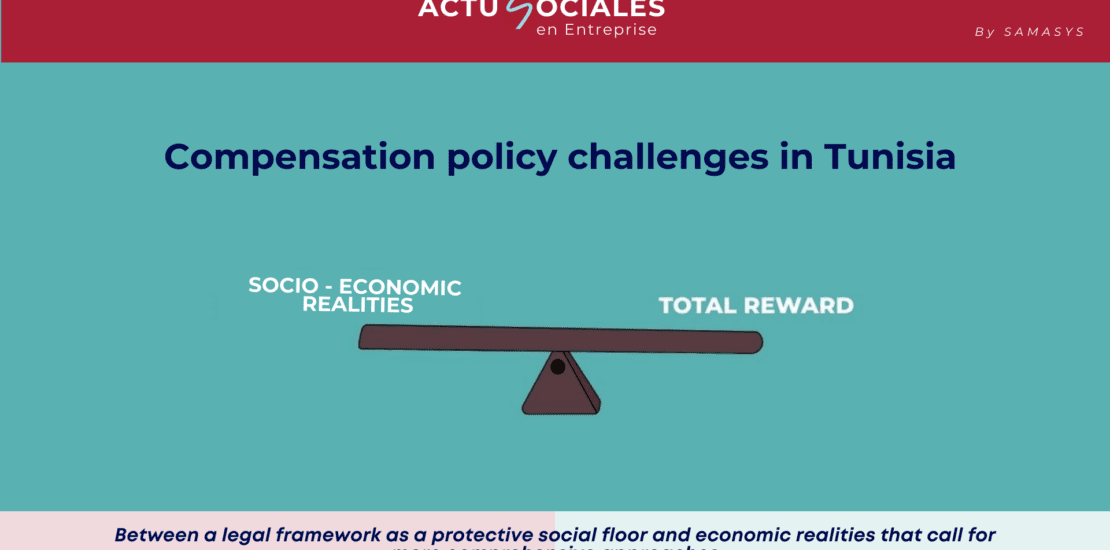
Today, compensation policy in Tunisia is caught between a legal framework designed as a protective social floor and economic realities that call for more comprehensive approaches, extending far beyond basic salary alone.
I. Why Are Companies Increasingly Benchmarking Salaries?
The growing reliance on salary benchmark studies is first and foremost a symptom rather than a solution in itself.
Several factors converge:
-
Increasing pressure on certain skills, particularly technical, digital, and managerial profiles;
-
Persistent recruitment and retention challenges, including for roles that were historically considered stable;
-
Internal pressure, reflected in individual or collective salary claims;
-
External market pressure, fueled by mobility, poaching, and constant inter-company comparison.
In this context, salary benchmarking becomes a reassurance tool for employers: it helps them position themselves, justify pay gaps, or sometimes rationalize decisions already under consideration. However, it constitutes neither an absolute truth nor a structural solution on its own.
This leads to an essential question: if the Tunisian framework is so highly regulated, why is there such a growing need for external benchmarks?
III. A Two-Speed Tunisian Labor Market
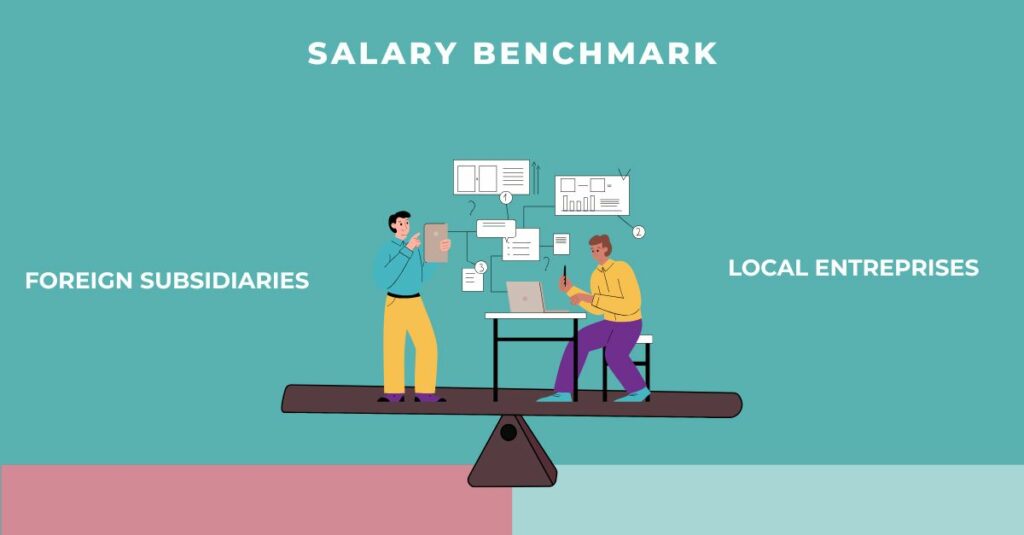
One of the key explanatory factors lies in the increasing polarization of the Tunisian labor market.
On one side are companies operating mainly within the local economy, characterized by:
-
constrained margins,
-
sometimes more traditional business models,
-
varying levels of organizational complexity.
On the other side are subsidiaries or companies with foreign capital, integrated into international groups, characterized by:
-
higher performance and skills requirements;
-
more structured and demanding work organizations;
-
international standards in governance, compliance, and reporting;
-
generally higher financial capacity.
This structural gap directly impacts:
-
the actual level of responsibility attached to roles,
-
the skills expected,
-
and, consequently, the legitimacy of remuneration levels exceeding legal minimums.
This is not a challenge to the social framework, but rather an economic reading of the diversity of situations.
IV. The Side Effects of a System Focused on Gross Salary
When compensation is viewed almost exclusively through the lens of gross salary, several distortions emerge:
-
Poaching practices that sometimes lead to unsustainable salary bidding wars;
-
Wage inflation disconnected from real value creation;
-
Social demands concentrated on cash compensation, to the detriment of other levers;
-
Growing frustration on both the employer and employee sides, due to expectations that are difficult to reconcile.
In other words, the challenge is not only the level of pay, but the fact that professional recognition is often reduced to salary alone, whereas it could take many other forms.
V. Rethinking Compensation: Toward a Holistic “Compensation & Benefits” Approach
In this context, more and more companies are moving toward a holistic compensation approach, incorporating the concept of Compensation & Benefits or Total Reward.
This approach is based on a simple idea: compensation is not limited to salary.
It may include non-financial or indirectly financial levers, such as:
-
flexible working time arrangements,
-
collective transportation solutions,
-
childcare or education support,
-
workplace well-being and quality of life,
-
stability, contractual clarity, and long-term career visibility.
In certain contexts, these elements contribute more to engagement and retention than purely salary-based increases, which are sometimes quickly neutralized by inflation or taxation.
In some cases, quality of life offsets salary escalation more effectively than wage competition.
VI. Conclusion – Toward a More Mature Approach to Compensation
Salary benchmarks remain useful tools, but they cannot constitute a universal answer. Labor law, for its part, sets an essential minimum framework. Compensation policy is, fundamentally, an act of management and strategy.
In a changing economic environment, rethinking compensation requires a broader and more structured vision, integrating:
-
the legal framework,
-
economic realities,
-
human expectations.
This reflection is not intended to replace benchmarking work conducted by compensation specialists, but rather to highlight the importance of a complementary, more technical and regulatory reading of salary structuring.
Only under these conditions will companies be able to move beyond current tensions and build compensation policies that are fair, sustainable, and attractive.